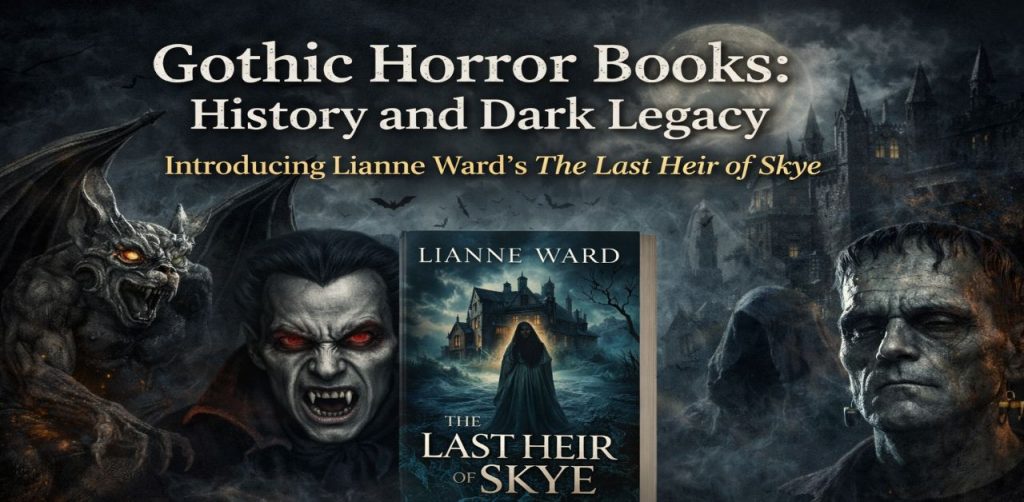
In the shadows of forgotten castles and among the secret paths of forests lies a unique type of literature: Gothic narrative (the origin of horror literature). As a writer and reader of the genre, Lianne Ward tells you why she loves Gothic horror books and why you should read her new book,The Last Heir of Skye.
Introducing Lianne Ward’s The Last Heir of Skye
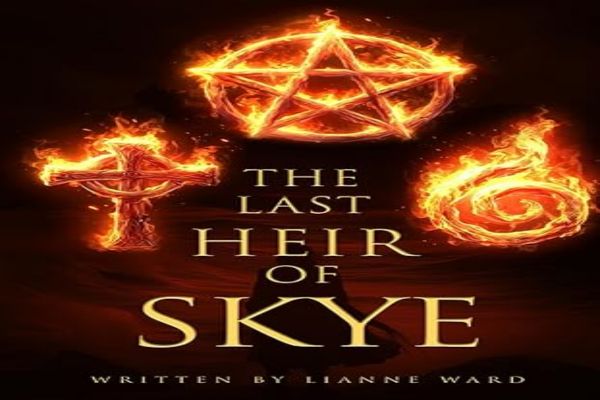
What if losing everything is just the beginning? In The Last Heir of Skye, Lianne Ward draws readers into a compelling story of broken dreams and new beginnings. Set against a dramatic Scottish landscape, one woman must rebuild her life from the ruins, shaping her own future with determination, resilience, and hope. Ward’s vivid writing brings to life the intensity of raw emotion and the power of the human spirit, offering a tale as memorable as the Scottish Highlands themselves.
But first, what is Gothic literature?
Gothic literature is a genre deeply influenced by ghost stories and medieval horror legends that form part of European folklore, not forgetting the influence of monstrous creatures and other such wonders, often rooted in classical mythology. All these elements play a crucial role in constructing the supernatural and the sinister, aiming to transgress the limits of reason.
Gothic emerged in the 18th century, challenging Enlightenment logic, which asserted that everything should be analyzed, explained, and understood through intellect. So, what lies at the opposite extreme of logic? A ghost!
Gothic narrative, or “ghost literature,” is the origin of horror literature.Gothic horror books are a genre that seeks to astonish readers through the use of the aforementioned elements. This type of narrative has evolved over the centuries and differs from later movements such as modern horror, gore, or creepypastas.
The Origin of Gothic Literature
Gothic literature originated in England during the second half of the 18th century, during the Enlightenment. To understand the reasons, we must recognize that things were changing at that time (much as they are now with the implementation of artificial intelligence), and that social reality was increasingly understood through the lens of science, reason, and technological revolutions.
But many people were not willing to abandon the mysteries linked to life: the supernatural, death, archaic legends, prophecies…
Why “Gothic” if it originated in the 18th century?
Castles, towers, monasteries, and cathedrals (all Gothic architecture) are typical settings in which many Gothic authors set their stories and develop their characters.
Furthermore, as we mentioned earlier, 18th-century writers drew inspiration from medieval legends, practices, and beliefs and we already know the quintessential architectural style of the medieval period: Gothic.
The First Gothic Novel In History
Did you know the first Gothic novel was published in 1764, written by Horace Walpole, and was titled ‘The Castle of Otranto’? This novel laid the foundation for the subsequent expansion of the genre. In its second edition, the author included the subtitle: “A Gothic Tale.
An interesting fact: Walpole did not use his own name when he released the first edition of ‘The Castle of Otranto’. It seems that a novel of this nature could have been detrimental to his reputation. Far from it, the book was a resounding success.
Following this story, which combined the author’s fondness for the medieval with a string of supernatural elements, other authors emerged who expanded the genre and began to lend it luster, helping to establish this marvelous literary movement.
Gothic Horror Books: Most Prominent Authors And Works
If we had to rigidly define the period encompassing early Gothic horror books, we should place it between the years 1764 and 1820:
- The Castle of Otranto (1764). Horace Walpole.
- The Old English Baron (1778). Clara Reeve.
- Vathek (1786). William Beckford.
- The Mysteries of Udolpho (1794). Ann Radcliffe.
- The Monk (1796). Matthew G. Lewis.
- Melmoth the Wanderer (1820). Charles Maturin.
Characteristics of Gothic horror books
Supernatural creatures: ghosts, witches, vampires, and other monstrous beings are essential in this type of narrative. These creatures awaken the protagonists’ most primal fears and unleash all kinds of extreme situations.
The characters are usually complex, enigmatic, and tormented, and for some reason, they are not very good at sharing their sorrows with friends and family. This is how unique characters emerge: solitary individuals, marked by dark secrets, past tragedies, and a constant inner struggle. Furthermore, the main characters are often immersed in forbidden passions and tragic loves, and the authors exploit the supernatural to heighten this romantic tension.
The antagonists, for their part, embody evil in its rawest, most twisted form, driven by sinister motives that lead them to commit terrible acts.
Another characteristic of this type of literature is the eternal struggle between good and evil.
So, in short, the protagonists have to deal with different challenges, especially those that will call their own sanity into question. This struggle provides powerful narrative tension and allows for the exploration of ethical and moral issues.
The settings of Gothic stories are usually imposing castles and mansions, shrouded in an aura of decadence and ruin. These gloomy, somber places provide the necessary climax for the plot’s most important events.
Evolution of Gothic Horror: Romanticism Arrived to Stay
In the 19th century, the genre evolved, leaving an indelible mark on the history of literature, thanks in part to a marvelous fusion between English Gothic and Romanticism. Following this, the genre introduced more complex themes and more elaborate characters.
Gothic maintained its raison d’etre for Romantic authors, but it shifted towards a different kind of horror. Darkness ceased to be merely the physical realm inhabited by vengeful spirits. From this moment on, darkness also manifested itself from the depths of the human mind (where familiar and intimate fears always reside).
During this time, the golden age of Gothic fiction, key works were published that would later become classics of world literature.
Frankenstein, Dracula, and a Raven
Frankenstein, first published in 1818, tells the story of scientist Victor Frankenstein and his creation: a creature made from different corpses. The novel explores themes of unbridled ambition, responsibility, and identity. Is there anyone on the planet who doesn’t know Frankenstein’s monster?
Dracula, published in 1897, introduces the iconic vampire Count Dracula, a being who intends to expand his reign of terror and misery beyond Transylvania. Bram Stoker creates a chilling atmosphere and uses narrative techniques such as diaries and letters to immerse the reader in the story. The vampire myth reaches its zenith with this novel.
Meanwhile, Edgar Allan Poe, best known for his short stories, also contributed his distinctive style to the Gothic genre. His unsettling and poetic tales, such as “The Raven,” “The Tell-Tale Heart,” and“The Masque of the Red Death,” to name just a few, explore the depths of the human psyche and have influenced the artistic development of many subsequent horror writers.
Thank you very much for reading to the end. If you enjoy Gothic horror books, be sure to explore The Last Heir of Skye and the collection of dark micro-stories I have been writing over the past few years.